Quick answer
Are your downspouts big enough? On most Northeast Atlanta homes the downspout, not the gutter, is the first part a hard rain overwhelms, so the fix for overflow is often a 3×4 downspout in place of a 2×3, or a second downspout on a run over 40 feet. NOAA puts the hardest hour Suwanee should expect in a typical year at 1.32 inches, with five minute bursts near 4.93 inches an hour, and every downspout has to keep up with those bursts; for a free written estimate call (770) 637-5130 or get a free quote.
The bottleneck
Why the downspout runs out first
A gutter is a channel. A downspout is a hole in the bottom of that channel. In a hard Georgia rain, the hole is usually where the system loses.
Every gallon that lands on a stretch of roof has to fit through the outlet at the end of the gutter. The outlet is the narrowest point in the whole system, and it is also where pine needles, leaves and sweetgum balls end up. When rain arrives faster than the outlet can take it, water backs up and spills over the front.
The Department of Energy’s Building America Solution Center makes the same point about sizing. A larger gutter conducts more water at a faster rate, its guide says, provided there are enough downspouts to drain it. The same guide calls for downspouts every 20 to 50 feet along the gutter and notes that the more closely they are spaced, the more water the system can move during peak rainstorms.
That is why our Solutionists look at the downspouts before they talk about bigger gutters. When a 5 inch gutter spills, the cause is often one overworked downspout, and a second outlet or a 3×4 fixes it without new gutters.
The overflow that is not a size problem
Before anyone changes a downspout, rule out the simple causes. A packed elbow, a crushed downspout or a run that has lost its slope will make any size of downspout look too small. If the spilling stops after a gutter cleaning and flush, size was never the problem. If a run still holds water in the middle a day after the rain, the hangers or the pitch need attention first, and that is a job for gutter repair.
Local rain
How hard it rains on a Northeast Atlanta roof
For a downspout, what matters is how hard the rain falls in the hardest few minutes, and NOAA publishes that for every town we serve.
NOAA Atlas 14 is the federal reference for rainfall intensity. Pulled from the NOAA Precipitation Frequency Data Server for Suwanee, it puts the hardest hour you should expect in a typical year at 1.32 inches. Inside that hour the rain is not steady. The hardest five minutes in a typical year fall at about 4.93 inches an hour, and in a 10 year storm the hardest hour reaches 2.10 inches.
To turn that into water at a downspout, multiply the roof area draining to it by the rainfall rate in inches per hour and then by 0.0104. One inch of rain on one square foot of roof is about 0.623 gallons, and spreading that over 60 minutes gives the 0.0104 figure, in gallons per minute.
| Rain at Suwanee | Rate | 600 sq ft of roof to one downspout | 1,200 sq ft of roof to one downspout |
|---|---|---|---|
| Hardest hour in a typical year | 1.32 in/hr | About 8 gal/min | About 16 gal/min |
| Hardest 5 minutes in a typical year | 4.93 in/hr | About 31 gal/min | About 62 gal/min |
| Hardest hour in a 10 year storm | 2.10 in/hr | About 13 gal/min | About 26 gal/min |
| Hardest 5 minutes in a 100 year storm | 11.7 in/hr | About 73 gal/min | About 146 gal/min |
Doubling the roof area that drains to one downspout doubles the water it has to carry. That is the case for a second downspout on a long run: it halves each downspout’s share without touching the gutter.
Source: NOAA Atlas 14, Volume 9, precipitation frequency estimates for Suwanee’s coordinates, pulled October 2026. Roof areas are round examples. Our Helene gutter check runs the same kind of math for your own town and home size.
Sizing
2×3 or 3×4: choosing the downspout
Residential downspouts come in two common rectangular sizes. The bigger one has about twice the opening, and knowing where each one belongs can save you from replacing gutters that are already the right size.
A 2×3 downspout measures about 2 by 3 inches across, roughly 6 square inches of opening. A 3×4 measures about 3 by 4 inches, roughly 12 square inches, so it has about twice the room for water and for the leaves and needles that ride along with it. We pair 5 inch gutters with 2×3 or 3×4 downspouts depending on how much roof drains to each one, and 6 inch gutters with 3×4.
| Where on the house | What we usually see | Usual downspout answer |
|---|---|---|
| Short garage run | A small roof area with one outlet | One 2×3, aimed so it does not wash clay across the driveway |
| Front run over the entry | Water spilling onto the steps when the only outlet sits at the far corner | A second outlet near the entry, or a 3×4 |
| Run over 40 feet with one outlet | The far end backs up before the water reaches the downspout | A second downspout, or a 3×4 where there is no room for one |
| Porch or sunroom under a two story wall | The lower gutter carries its own roof plus the upper gutter’s water | 6 inch on that run with its own 3×4 |
| Inside corner under a valley | Fast water jumps the corner in a storm | An outlet placed close to the corner |
| Large metal roof planes | Water sheets off and hits the trough fast | 6 inch gutters with 3×4 downspouts on the big planes |
Does a bigger downspout clog less?
A larger opening gives debris more room, but no downspout is clog proof under Georgia trees. Sweetgum balls roll to the low point and wedge in the elbows, and wads of needles collect where the downspout bends at the top. If you clean more than twice a year and still find plugged elbows, gutter guards that keep debris out of the trough are the longer term fix.
Placement
Where downspouts belong on the house
The right size in the wrong spot still overflows. Walk around the house during the next hard rain and you can usually see exactly where a downspout is missing.
- Start at the corners.Inside corners collect water from two roof planes at once. A downspout close to the corner drains it before it jumps the gutter.
- Find the valleys.Where two roof slopes meet, water pours onto one short stretch of gutter. An outlet nearby keeps it from shooting past the front edge.
- Measure the long runs.Under 40 feet, one downspout can usually carry a 5 inch run. Over 40 feet, plan on two or more. Past 60 feet, we look at 6 inch gutters with downspouts spaced for the length.
- Look upstream.If an upper gutter empties onto a lower roof, the lower gutter is carrying two loads, and that run often needs its own larger downspout.
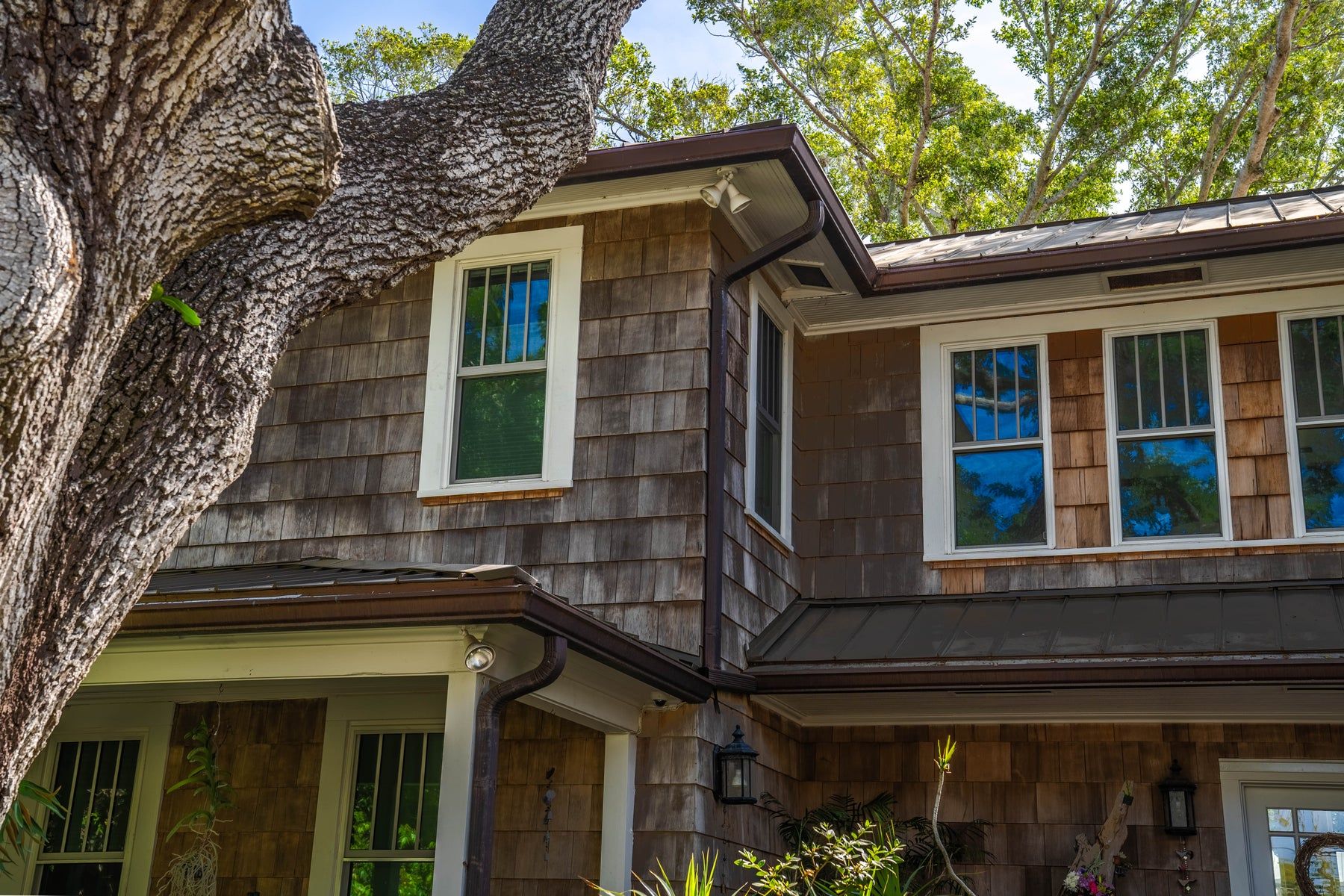
- Watch the bottom.Each downspout should end in an elbow turned away from the house, with an extension carrying the water out.
Adding a downspout or going to bigger gutters
Adding a downspout is usually the smaller job. Stepping up to a bigger gutter means replacing the run. When we do recommend a size change, we make it only on the runs that need it and leave the rest alone. On a two story home in Suwanee, Dacula or Cumming, that often means 5 inch up top and 6 inch on the lower runs that catch upper roof water. Homes in Johns Creek and Alpharetta with valleys pouring into corners often need 6 inch there. Our gutter sizes guide walks through how we decide.
- Every inside corner has a downspout within reach.
- No 5 inch run over 40 feet drains through a single outlet.
- Lower roofs that catch upper gutter water have their own downspout.
- Every downspout ends in an elbow turned away from the house.
At the ground
Where the water goes after the downspout
A bigger or extra downspout moves more water, faster, to one spot on the ground. Where that spot is matters as much as the size of the pipe.
The Department of Energy’s Building America guide says downspouts should end at least 5 feet from the foundation, onto ground that slopes away from the house so the water cannot run back. On red clay that matters more than most places. Water dumped at the wall soaks the loose backfill, hits the clay and sits against the foundation.
For most homes the answer is downspout extensions and redirects: a longer leader or a turned elbow that carries water past the beds and onto lawn that falls away from the house.
Rain barrels are another option in Gwinnett County. The county’s stormwater utility offers up to a 3 percent fee credit when each downspout is connected to its own rain barrel of at least 50 gallons, with partial credit if not every downspout is connected. At about 31 gallons a minute, a 50 gallon barrel under a busy downspout fills in under two minutes of a hard burst, so its overflow needs to head away from the foundation too.
Signs your downspouts are losing
- Water sheeting over the gutter right next to a downspout in a hard rain.
- A downspout that trickles while the gutter above it spills.
- Red clay splashed up the brick at the bottom of a downspout.
- A washed out channel or bare clay where a downspout empties.
- Water standing against the foundation hours after the rain stops.
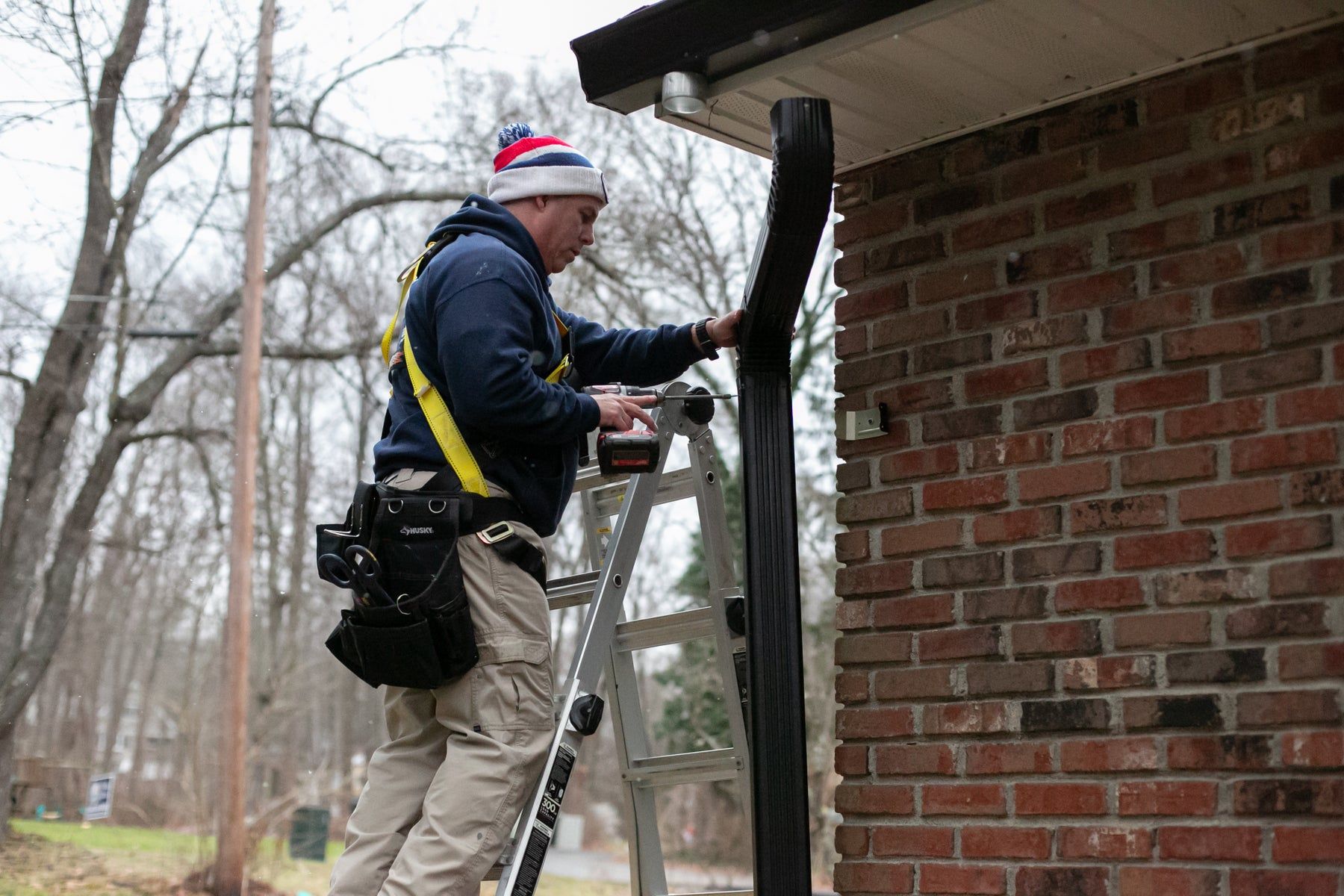
If you see any of those, have us take a look. Our crews flush every downspout while you watch and give you a written plan for size and placement. Worn out runs get new seamless gutters formed on site.
Gutters spilling in the hard rains? Have us check every downspout before the next storm. Call (770) 637-5130
Get a Free QuoteFrequently Asked Questions
Most 5 inch gutters drain through 2×3 or 3×4 downspouts, and the amount of roof feeding each outlet decides which. Long runs, corners under valleys and runs over the entry often do better with 3×4, which has about twice the opening. 6 inch gutters pair with 3×4 downspouts.
As a working rule, one downspout can carry a 5 inch run under about 40 feet, and longer runs need two or more. The Department of Energy’s Building America guide calls for downspouts every 20 to 50 feet and notes that closer spacing moves more water in peak storms.
Often, if the downspout was the bottleneck. A 3×4 or a second outlet can fix a run that spills near its downspout. If the overflow comes from a clogged elbow, a sagging run or a valley overshooting the gutter, it will not help. A flush test tells you which problem you have.
The Department of Energy’s Building America guide says at least 5 feet from the foundation, onto ground that slopes away from the house so the water cannot run back. Downspout extensions and redirects are the usual way to get it there.
Yes. Gwinnett’s stormwater utility offers up to a 3 percent fee credit when each downspout is connected to its own rain barrel of at least 50 gallons, with partial credit if only some downspouts are connected. Plan for overflow, because a barrel fills in minutes in a hard downpour.
Free estimates
Not sure your downspouts can keep up?
Book a free written estimate with our local crew. We will flush every downspout, look at the roof feeding each one and show you where a larger or extra downspout would stop the overflow, before you spend anything.
The Brothers That Just Do Gutters · Northeast Atlanta · (770) 637-5130 · Crews roll out of Suwanee, Marietta, Ball Ground and Watkinsville